

Audience and scholarly responses to Measure for Measure have been mixed across the centuries, enough so that it has been described as a “problem play.” The term, borrowed from the 19th century, was used to describe works that realistically treated a social problem. But as early as the 17th century readers have had “problematic” responses to the play as one reader’s dramatic reaction to the play in the Second Folio attests. These collection items show responses—by a government, by a student, and by artists—over the centuries.
A 17th century censor

This Second Folio belonged to the College of St. Alban, a Jesuit college, in Valladolid, Spain and was censored during the Spanish Inquisition, a judicial institution that brutally eradicated religious heresy in Catholic Spain while also solidifying the monarchy’s power. Measure for Measure was physically cut out of this book sometime after 1641!
Scholars today believe that the censor who cut out the play, Guillermo Sánchez, was likely an English Catholic exile named William Sankey. Although scholars don’t know how exactly the task of censoring Shakespeare’s works became Sánchez’s responsibility, no section of the plays escaped his pen. He even found something on the first page of the very first play in the very first scene of The Tempest to censor! Sánchez mostly inked out specific lines that he found to be too sexual in their nature or to express anti-Catholic rhetoric. However, Sánchez found Measure for Measure’s dramatic action involving the deputy Angleo coercing the novice Isabella to sleep with him to save her brother’s life so offensive that he cut the entire play out!
View this post on Instagram
A 19th century literature student
Many European universities did not start teaching English literature as a formal course of study until the second half of the 19th century. Trinity College in Dublin, Ireland, founded in 1592 by Queen Elizabeth I to strengthen the Protestant Reformation in the Catholic colony, began offering degrees in literature in the late 1850s. Shakespeare’s plays were included in the original curriculum. In 1860, a young student named James Rowley studied five of Shakespeare’s tragedies (Macbeth, Hamlet, Othello, Romeo and Juliet, and King Lear) and five of his comedies (The Merchant of Venice, Measure for Measure, The Tempest, A Midsummer Night’s Dream, and As You Like It) as part of his degree at Trinity.
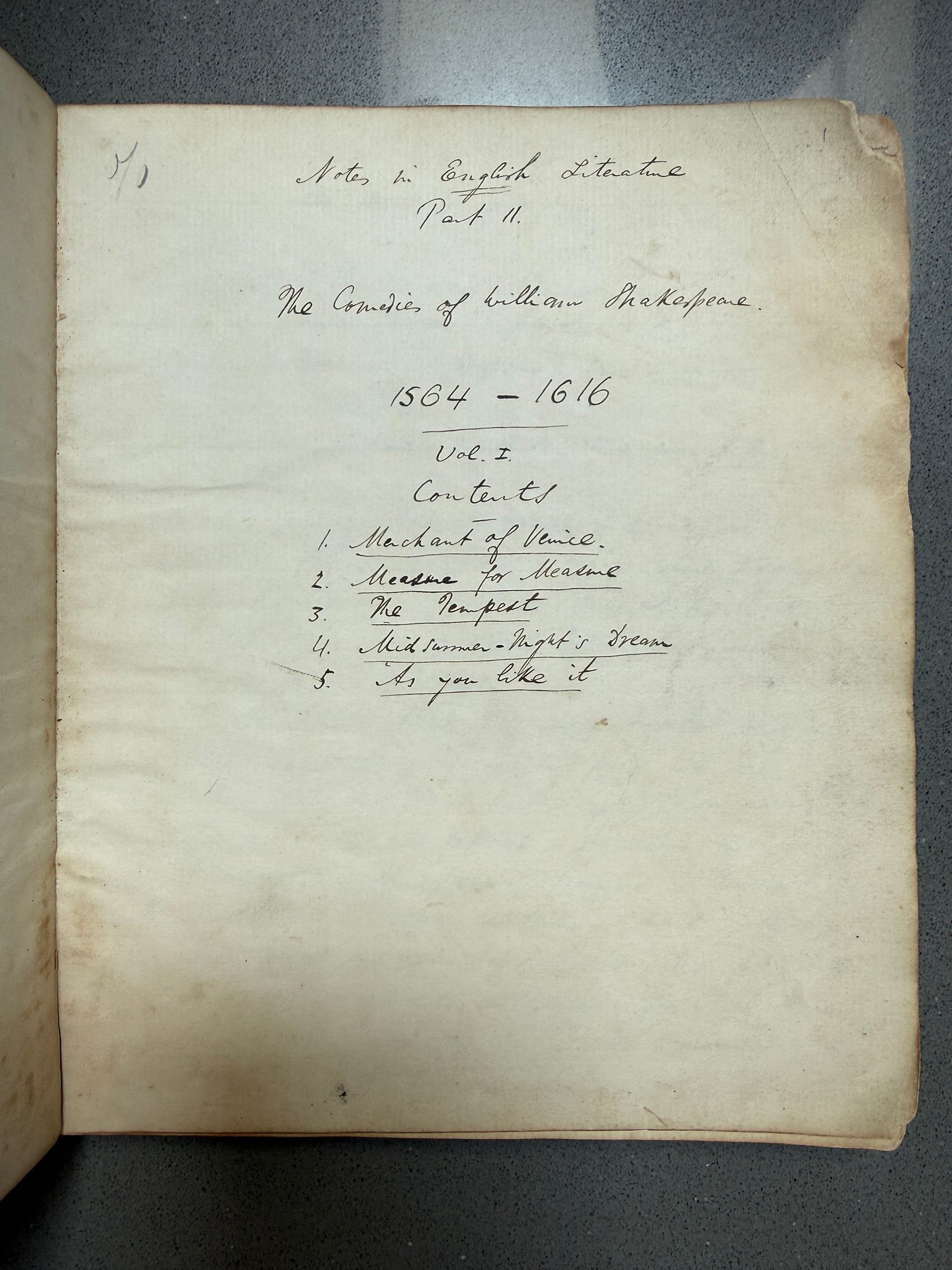

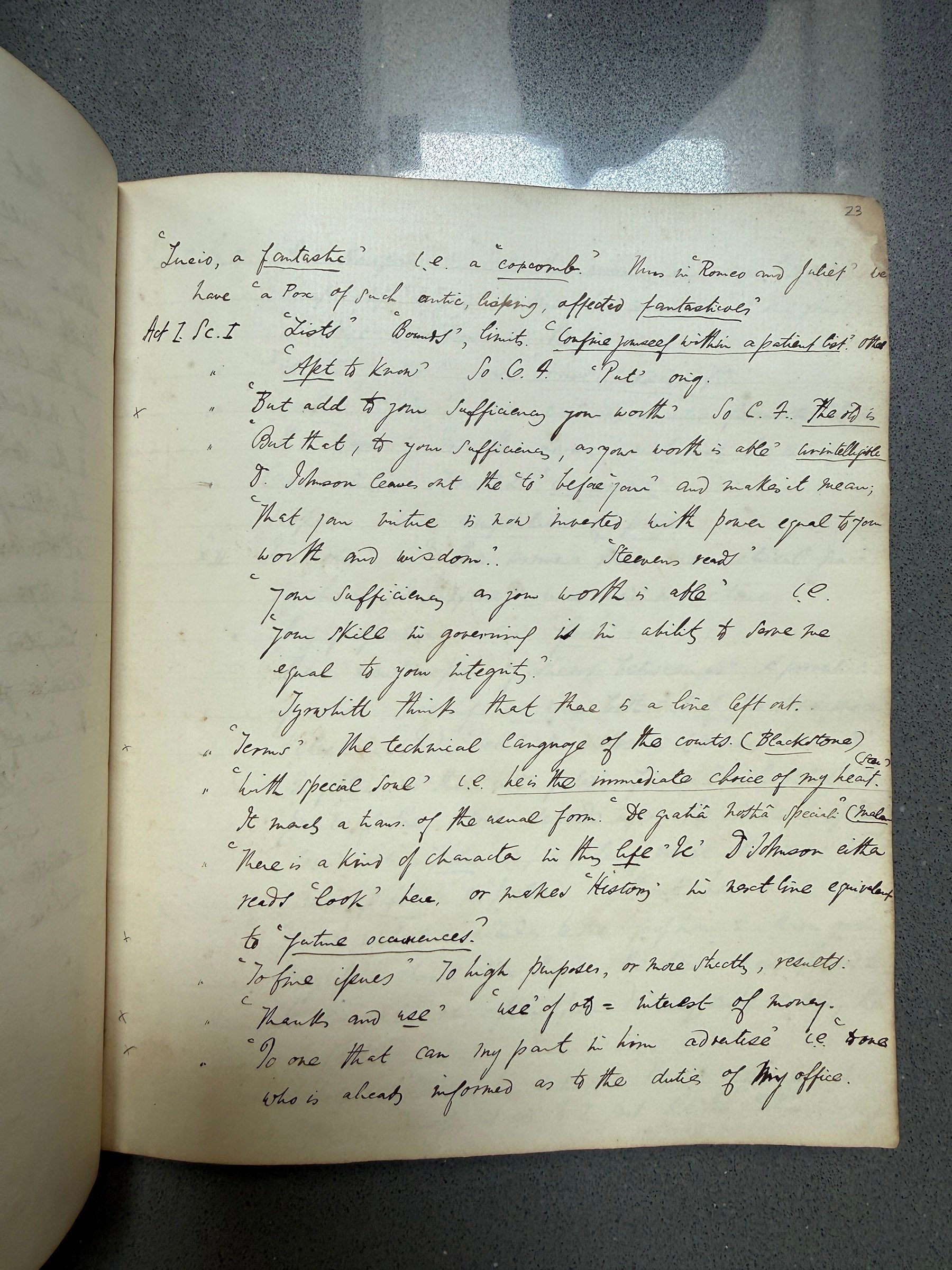
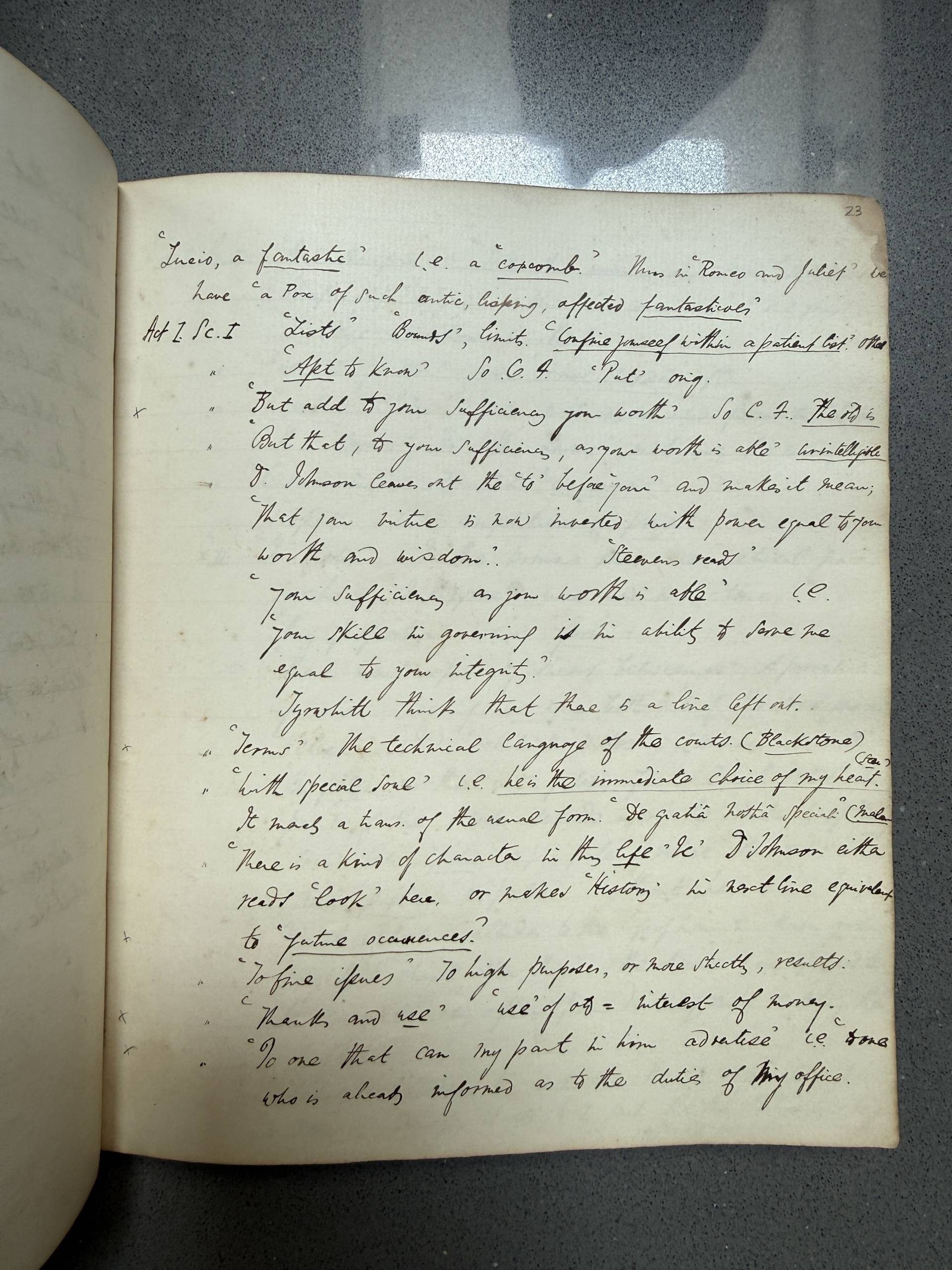
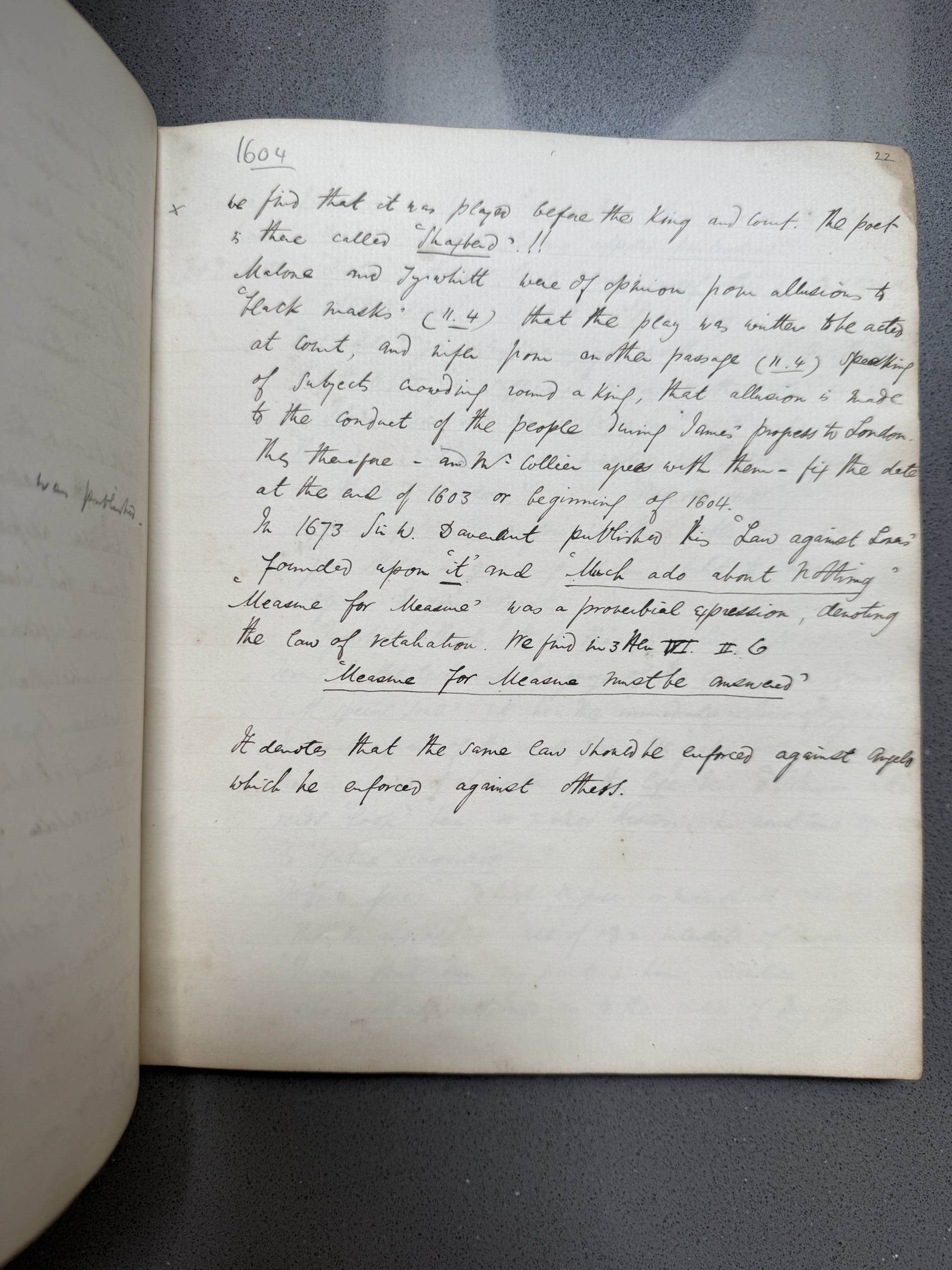
James Rowley, Notes in English literature
Rowley recorded publishing history, performance history, and textual analysis of Measure for Measure as part of his studies. He drew. Rowley’s literature courses seemed to have been a formative experience as he would go on to become one of the two founding professors at University College Bristol, lecturing on English literature – and quite possibly the works of Shakespeare he himself had studied while at Trinity.
20th century artists
Siblings Mary and Charles Lamb compiled Tales from Shakespeare in 1807 with the belief that young children should read Shakespeare. They chose to omit all history plays and Roman plays with Charles adapting the tragedies and Mary the comedies. Despite Mary’s contributions to half of the book, she was not credited on the title page until the seventh edition (1838). The work has never been out of print.
One example of the book’s enduring popularity can be seen with three illustrated editions in the Folger’s collection, each designed by a prominent illustrator of their time, and all published between 1900 and 1910. The moments in the story that each artist selected to illustrate vary, offering three different opportunities to visualize the play itself.
Charles and Mary Lamb, Tales from Shakespeare
Illustrated by Arthur Rackham


Arthur Rackham (1867–1939) is recognized as one of the leading figures of the Golden Age of British book illustration. Although Rackham originally illustrated newspapers, his talent for whimsical pen, ink, and watercolor drawings eventually drew him to book illustration. In his career, he would illustrate works of Shakespeare several times, including A Midsummer Night’s Dream and The Tempest. While some of the plays in a 1901 edition he illustrated with full scenes, Measure for Measure only received a generalized treatment of the title.
Illustrated by W.H. Robinson


Heath Robinson (1872–1944) was an English cartoonist, illustrator, and artist. Like Rackham, he provided the art for an edition of the Lambs’ Shakespeare. During his lifetime, Heath Robinson’s name became an adjective in the UK to describe anything wildly creative and ridiculously complex—much like his American contemporary Rube Goldberg. This illustration of Claudio in prison seems markedly restrained compared to Robinson’s signature style.
Illustrated by W. Paget


Walter Paget (1862–1935) illustrated newspapers, magazines, and children’s books, receiving a gold medal from the Royal Academy of the Arts for his achievements. Unlike Rackham and Robinson, these illustrations for a 1901 edition of Mary and Charles Lambs’ Tales from Shakespeare would be the only time the artist illustrated any of Shakespeare’s plays.
On exhibit
through November 15, 2026

Our Shakespeare Exhibition
Keep exploring

Quiz: How much do you know about Measure for Measure?
Try our quiz about Measure for Measure to explore the characters and events of Shakespeare’s remarkable play.

W. Heath Robinson: Shakespeare Illustrated by "Britain's Rube Goldberg"
Known for his complex imaginary contraptions, W. Heath Robinson also produced exquisite illustrations for editions of Shakespeare’s works.

The sanitized Shakespeare of Mary Lamb and Henrietta Bowdler - Excerpt: 'Shakespeare's Lady Editors' by Molly Yarn
As anyone who has read Shakespeare’s plays can attest, their content is not always very appropriate for children: brutal murders, bawdy jokes, incest, etc. Editions of Shakespeare’s plays that have been designed specifically for children often omit or smooth over…
Stay connected
Enter your email address to follow this blog and receive notifications of new posts by email.