


In The Stolen Crown: Treachery, Deceit, and the Death of the Tudor Dynasty, acclaimed royal historian Tracy Borman tells the dramatic and untold story of the lie about the controversial succession that ended the Tudor era and launched the Stuart reign in March 1603. On her deathbed, did Elizabeth really name James her successor, and was the illegitimacy of James’ claim to the throne the beginning of its destruction?
 IN MARCH 1603, QUEEN ELIZABETH I, THE LAST TUDOR MONARCH, LAY DYING AT RICHMOND PALACE, HER FAVOURITE RETREAT WEST OF LONDON. She had reigned for forty-four years, longer and more successfully than any of the other Tudor monarchs. The forgotten younger daughter of Henry VIII, Elizabeth had had her right to the throne withdrawn in 1536 following the execution of her mother, the ‘Great Whore’, Anne Boleyn, and had been declared a bastard. The stain of illegitimacy could not easily be scrubbed away, as her grandfather, Henry VII, had found to his cost. Even when he was well established on his throne, the founder of the Tudor dynasty had been scorned by one foreign ambassador for having ‘a drop of doubtful Royal blood’. Furthermore, Elizabeth had had two siblings ahead of her in the line of succession: her younger half-brother Edward and her elder half-sister Mary, with the ‘nine days’ queen’ Lady Jane Grey sandwiched in between. Yet within just eight years of her father’s death in 1547, all three had followed him to the grave, leaving Elizabeth as the sole heir to the Tudor dynasty. A brilliant propagandist, she had turned the widespread horror at her unmarried state into a dazzling virtue, becoming the Virgin Queen of legend.
Elizabeth may have been celebrated for her virginity, but the price she and her subjects had paid was uncertainty over who would succeed her. Her determination not to settle the succession had given rise to fierce rivalry between the blood claimants to the English throne, among them Mary, Queen of Scots and her son James VI; Arbella Stuart; Lady Katherine Grey and her descendants; and Henry Hastings, Earl of Huntingdon. The discord had spilled out into the court and across the kingdom as a whole.
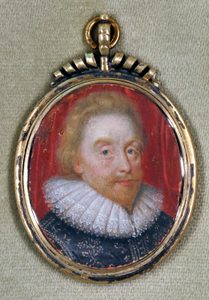
This miniature, believed to depict King James I, was painted and framed as a pair (with a miniature of Queen Anne) by an unidentified artist. The style of the monarchs’ attire and ruffs, especially Anne’s standing wired lace ruff, suggests they were made around 1620.
By 1603, James VI had apparently emerged as the favourite. His legitimacy, lineage, gender and religion gave him the edge over his rivals, even if there were still doubts over the legality of his claim. ‘I hear none almost call it in question,’ the Earl of Northumberland assured him at the time. The fact that the King of Scots had two sons also worked in his favour: if he should succeed, the future of the monarchy seemed secure. Even the Queen’s adoring godson, Sir John Harington, looked forward to the day when England would no longer be governed by an elderly and increasingly reclusive woman ‘but by a man of spirit and learning, of able body, of understanding mind, that in the precepts he doth give to his son shows what we must look for, what we must trust to’. In ever greater numbers, Elizabeth’s subjects flocked north to ingratiate themselves with the Queen’s likely successor. According to her earliest biographer, William Camden: ‘They adored him as the sun rising, and neglected her as now ready to set.’
It was also Camden who described how, when the dying Queen’s anxious ministers clustered around her bed, Charles Howard, Earl of Nottingham and Lord High Admiral, urged her to settle the succession once and for all. At length, she replied that her closest blood relative, James VI, should inherit her crown, declaring: ‘I’ll have none but him.’ She died shortly afterwards and the throne of England passed peacefully to the King of Scots.
This scene has been replayed (and embellished) numerous times in the four hundred or so years since Elizabeth’s death. It first appeared in 1615, when Camden published the first instalment of his monumental work Annales: The True and Royall History of the Famous Empresse Elizabeth. His account soon became the official version of the Stuart succession as a rightful and smooth transition from one monarch—one dynasty—to the next. Given that Camden was close to some senior members of Elizabeth’s court, historians have relied on his manuscript as one of the most important and accurate sources for the period. It has therefore shaped our view of the last years of Elizabeth and the early reign of her successor.
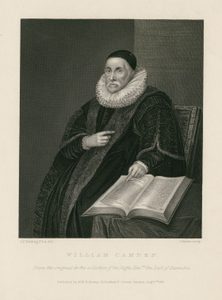
William Camden
But detailed analysis of Camden’s original manuscript published by the British Library in 2023 revealed that key passages were pasted over and rewritten after Elizabeth’s death to make them more favourable to her successor. Thanks to advances in enhanced imaging, concealed lines can be read for the first time, offering a deeper insight into the political machinations of Elizabeth’s court. They suggest that Camden was so concerned not to offend the new king that he rewrote key sections of his manuscript, pasting new pages over his original text. Among the findings are that Elizabeth’s last-gasp naming of James as her heir was a work of fiction, designed to make his accession appear more predetermined than it had been. The real story of the Elizabethan succession was altogether darker and more turbulent than Camden’s fiction.
If the truth had been more widely known at the time, it would have had profound repercussions for the Stuart succession. Rather than welcoming James as the king to whom ‘Good Queen Bess’ had given her blessing, the people of England might have refused to accept him. After all, England and Scotland had been bitter enemies for centuries, the fleeting periods of peace cut abruptly, bloodily short by the clash of arms or threat of invasion. William Camden had lived through the reigns of all three of Henry’s children and was also author of Britannia, a detailed history of Great Britain, so was well versed in Anglo-Scottish hostility. He therefore would have appreciated the crucial importance of smoothing the path for the new Stuart regime which, by the time that his biography of Elizabeth was published, was already looking dangerously unstable.
Using this new research as a springboard, The Stolen Crown will tell the dramatic story of the end of the Tudor dynasty and the rise of the Stuarts. Far from being a peaceful transition, it was a time of turbulence and uncertainty, conspiracy and persecution, witchcraft and gunpowder. With the accession of England’s first Stuart monarch, everything was transformed: from court culture to royal ceremony, religious tolerance to parliamentary authority, morality to witch hunting. Two countries that had been fierce rivals for centuries were now forged into an uncomfortably United Kingdom.
And it had all begun with a lie.
Excerpted from The Stolen Crown © 2025 by Tracy Borman Inc Ltd. Reprinted with the permission of the publisher, Grove Press, an imprint of Grove Atlantic, Inc. All rights reserved.

About the author
Tracy Borman is Chief Historian of Historic Royal Palaces, Chief Executive of the Heritage Education Trust, and Chancellor and Professor of Tudor History at Lincoln Bishop University. She is the author of many highly acclaimed books, including The Stolen Crown; Anne Boleyn and Elizabeth I; Crown and Sceptre; Henry VIII and the Men Who Made Him; The Private Lives of the Tudors; Thomas Cromwell; Queen of the Conqueror; Elizabeth’s Women; Witches; as well as the trilogy of novels The King’s Witch, The Devil’s Slave, and The Fallen Angel. Borman is also a regular broadcaster and accomplished public speaker. She was awarded an OBE in the King’s Birthday Honours 2024 for services to heritage.
Keep exploring

Elizabeth I Sieve Portrait
George Gower’s 1579 portrait of Elizabeth I is the earliest of several paintings that show the queen holding a sieve.

The Six Loves of James I, with Gareth Russell
James I was a multifaceted ruler who led a fascinating life—and his romantic relationships with both men and women guided its often-turbulent course. Historian and author Gareth Russell reveals the untold story of his life and loves.

Shakespeare and the British Royal Family, with Gordon McMullan
Shakespeare wrote a lot about English kings and queens. Over the last three hundred years, a lot of English kings and queens have gotten really into Shakespeare.
Stay connected
Enter your email address to follow this blog and receive notifications of new posts by email.