

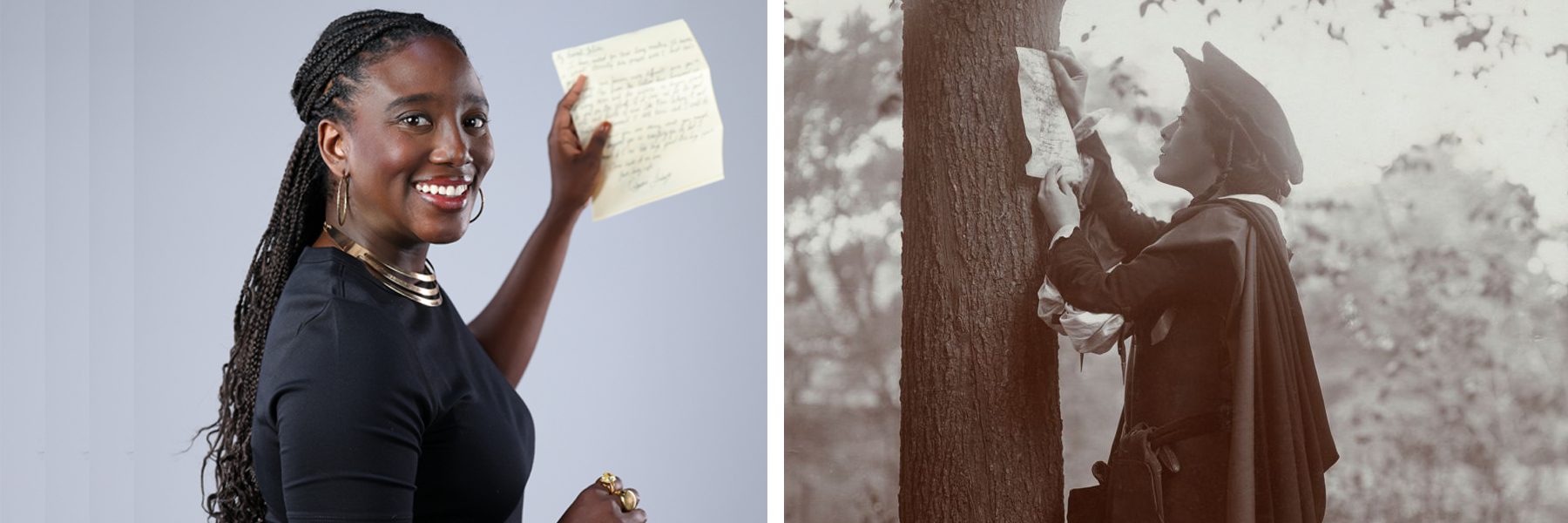
In Shakespeare’s As You Like It, Rosalind and Celia are forced from court and seek refuge in the Forest of Arden—a space where hierarchy softens and imagination restores what power has fractured. Folger Theatre’s 2026 staging of the play—a love letter to Washington, DC, as envisioned by Artistic Director Karen Ann Daniels and directed by Timothy Douglas—infuses the Forest of Arden with the vibe, culture, and characters of DC’s residential neighborhoods, a singular, resilient, and redemptive place of belonging. Costume designs for the Folger’s 2026 production and a 1903 map of Washington, DC, in the Folger collection show the production’s movement between the court and Arden. It inspired us to time travel back to the early 20th century when the map was drawn and the Ben Greet Players were bringing outdoor Shakespeare performances to college campuses across the United States—and eventually to the front lawn of the White House.

Contrasting the court and the forest
As You Like It contrasts the constrained court with the liberating Forest of Arden. While the court is filled with rivalry and ambition, Arden offers freedom and reflection. The Folger’s production envisions the federal government as the court and the DC neighborhoods as the forest. This architectural map, drawn several decades before the Folger was built, highlights the contrast between the public and the private spheres of Capitol Hill.


Power dressing
With the Folger Theatre production’s costumes, designer Celeste Jennings hopes “to highlight real people who are rooted in their personalities and their characteristics and ethnicities.” In the first sketch for Rosalind at court, she raises her fist—a global symbol of solidarity and resistance. In the second sketch, Rosalind has slipped into the freeing atmosphere of the forest and adopted the masculine-coded disguise of Ganymede.
These selections from the Artistic Programs team, working with Folger curators, are on view in the On Stage case in the Out of the Vault gallery from March 10 through June 9, 2026.
As You Like It and the great outdoors
The Folger collection is home to many materials related to the performance of As You Like It. Because much of the play’s action takes place in the Forest of Arden, the play has been a popular choice for “open-air” performances staged completely outside.


Ben Greet’s As You Like It
The Folger holds materials related to Ben Greet’s 1903 outdoor production of As You Like It. Greet was a personal friend of Henry and Emily Folger. This production took place on Columbia University’s “South Field,” a space that was often used for sporting events until the early 1920s. Today it is known as South Lawn and sits in the middle of the university’s campus. The Folger archives also holds a program from this performance which Henry and Emily themselves attended on May 14, 1903.


Heard on the Folger’s Shakespeare Unlimited podcast, Shakespeare Outdoors:
From the New York Herald Tribune, 1903:
At South Field, Columbia, yesterday afternoon, New York society and New York lovers of the drama to the number of thirty-five hundred sat in the sun and witnessed a production novel to this city, the forest scenes from As You Like It played on the lawn with shrubs and flowers for a foreground and the trees and interlaced boughs for a background and proscenium arch.
This article from the New York Herald Tribune is describing what is thought to be the first ever outdoor performance of Shakespeare in America, Ben Greet’s Woodland Players at Columbia University on May 15, 1903. The paper called the performance “a real glimpse into an earlier time.” More than 100 years later, the newspaper coverage of the event does much the same thing.
The performance was given under the patronage of many of the best known women of the city, so that the audience was exceptionally brilliant. The spring toilettes of the women, who formed the principal part of the audience, added to the picturesqueness of the scene. Among those present were Mrs. Elliott F. Shepard in a black crepe de chine, a mauve feather boa and a hat trimmed with mauve feathers; and Mrs. Gladys Vanderbilt, in a frock of blue cloth with a large flat yellow straw hat trimmed with bluets.
In addition to the 3,500 who sat on flexible camping stools near Broadway and 114th Street, news reports say people crowded the upstairs windows of nearby apartment buildings to catch a glimpse of the performance. New York society ladies arranged for Greet’s actors to have a military band for accompaniment. Between scenes, a glee club sang Elizabethan songs. The weather cooperated, though not everything went smoothly. People in the back who couldn’t hear all got up and moved to the stage a few minutes into the performance. And, because of bad planning, by the middle of the show, everyone in the audience was staring directly into the sun. But the Columbia performance raised $10,000 for local kindergartens. And after it was over, Greet and his actors boarded trains for a trip that took them to Baltimore and Chicago, then up into Canada, back down to Providence, and finally Boston, where they performed Comedy of Errors and As You Like It for 1,600 people in a small quad behind Sever Hall at Harvard…
Greet’s American tour was a smash, and his American producer, Charles Frohman, made sure it kept up. For most of the next 11 years until the outbreak of World War I, he brought Greet back, exposing more and more American cities to this new phenomenon. Greet came to Washington, DC, in 1904 and did a show in a park overlooking the current location of the Kennedy Center. He performed there again the following year, and then moved uptown to the park that now holds the National Zoo. Greet performed outdoors and indoors in New York to rave reviews. While there was one disappointment in Los Angeles, when fewer than 50 people showed up to watch Twelfth Night, Greet’s troupe scored their biggest coup in America in 1908, when First Lady Edith Roosevelt invited them to perform on the front lawn of the White House. Though Greet’s troupe didn’t actually perform any Shakespeare at the White House, that show turned out to be the launching point for what sealed in the American mind the idea that it was acceptable and even preferable to perform Shakespeare outdoors. That happened in 1913, when Ben Greet’s troupe was invited to perform on the Chautauqua circuit.


Ben Greet pioneered open-air theater, performing before millions of schoolchildren throughout his career. He passionately promoted the educational value of drama, especially Shakespeare’s plays. In 1912, Greet edited the series The Ben Greet Shakespeare for Young Readers and Amateur Players. These annotated acting texts of the plays most frequently performed by his troupe, The Woodland Players, provided advice on acting, directing, and pronunciation. They also carried on the tradition of earlier 19th-century acting editions by including diagrams of how to stage specific scenes in the plays. The Folger holds Henry and Emily Folger’s personal copies of Greet’s acting editions for As You Like It and The Comedy of Errors.


On stage and on exhibit

As You Like It

Out of the Vault
Keep exploring

Shakespeare Outdoors
Pack the picnic basket. Grab a blanket. Don’t forget the bug spray. Shakespeare under the stars is a long-standing tradition in America and around the world. Explore the social and cultural forces that came together to create outdoor Shakespeare festivals.

Ben Greet: “Thank God for Henry Clay Folger”
Learn about a friend of the Folgers who was considered by some to be the father of the open-air theatre, played before a million schoolchildren, and spent much of his life promoting the educational value of drama in general, and Shakespeare in particular.

As You Like It as an early Shakespeare talkie
In 1936, Britain’s first feature-length Shakespeare “talkie” premiered: As You Like It featuring Elisabeth Bergner and Laurence Olivier in his first Shakespeare role on screen. Explore the film’s press kits and study guides.
Stay connected
Enter your email address to follow this blog and receive notifications of new posts by email.