


You’re likely familiar with the now iconic phrase, “Beware the Ides of March!” But what exactly are Ides? And how did Shakespeare’s Julius Caesar help cement them in the popular imagination? We explore the significance of the Ides of March in Rome and in Elizabethan England.
What is the significance of the Ides of March?
The Ides of March is the date of the assassination of Julius Caesar in 44 BCE, a turning point in Roman history. In Shakespeare’s Julius Caesar the character of the Soothsayer warns Caesar—twice!—”Beware the Ides of March.”
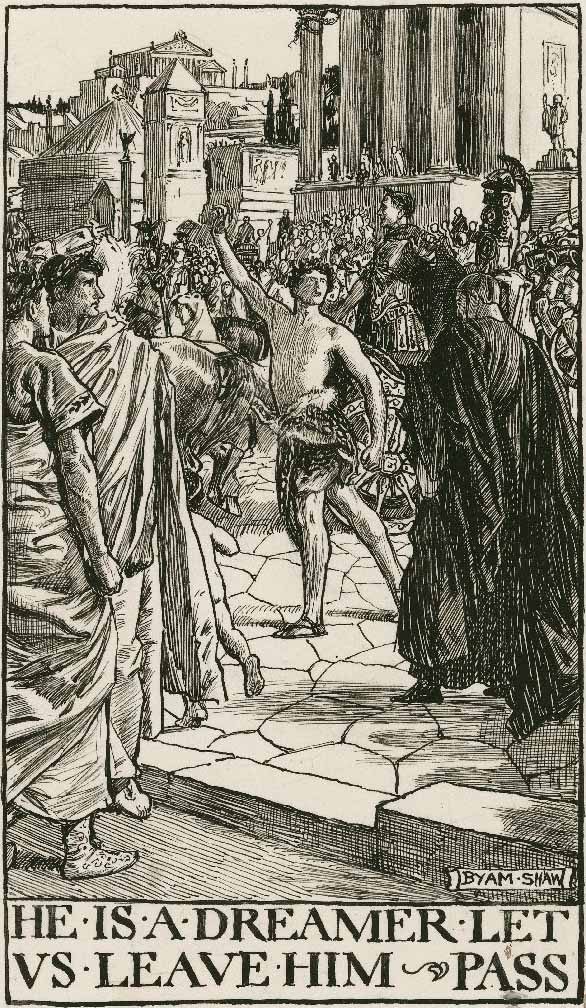
CAESAR: Who is it in the press that calls on me?
I hear a tongue shriller than all the music
Cry “Caesar.” Speak. Caesar is turned to hear.
SOOTHSAYER: Beware the ides of March.
CAESAR: What man is that?
BRUTUS: A soothsayer bids you beware the ides of March.
CAESAR: Set him before me. Let me see his face.
CASSIUS: Fellow, come from the throng. [The Soothsayer comes forward.] Look upon Caesar.
CAESAR: What sayst thou to me now? Speak once again.
SOOTHSAYER: Beware the ides of March.
—Julius Caesar, Act I, Scene 2
Caesar dismisses these warnings and those of his wife, Calphurnia, who describes terrible omens happening in Rome. She tells him of a lioness giving birth in the streets, graves opening to reveal the dead, and warriors fighting in the clouds and dripping blood onto the Capitol. Caesar is almost convinced to stay home but ultimately goes to the Senate believing that he will be crowned but only if he shows no fear. He is stabbed to death in the Senate by a group of 60 conspirators led by Brutus and Cassius.
CALPHURNIA: Caesar, I never stood on ceremonies,
Yet now they fright me. There is one within,
Besides the things that we have heard and seen,
Recounts most horrid sights seen by the watch.
A lioness hath whelpèd in the streets,
And graves have yawned and yielded up their dead.
Fierce fiery warriors fought upon the clouds
In ranks and squadrons and right form of war,
Which drizzled blood upon the Capitol.
The noise of battle hurtled in the air,
Horses did neigh, and dying men did groan,
And ghosts did shriek and squeal about the streets.
O Caesar, these things are beyond all use,
And I do fear them.
CAESAR: What can be avoided
Whose end is purposed by the mighty gods?
Yet Caesar shall go forth, for these predictions
Are to the world in general as to Caesar.
CALPHURNIA: When beggars die there are no comets seen;
The heavens themselves blaze forth the death of
princes.
CAESAR: Cowards die many times before their deaths;
The valiant never taste of death but once.
Of all the wonders that I yet have heard,
It seems to me most strange that men should fear,
Seeing that death, a necessary end,
Will come when it will come.
—Julius Caesar, Act II, Scene 2

What are Ides?
The Romans did not number the days of the month, but instead counted back from fixed points, the Nones (the beginning of the month, the 5th or 7th), the Ides (the middle) and the Kalends (the first of the following month and the origin of the word calendar). “Ides” comes from a Latin word meaning “to divide,” and fell on the 13th or the 15th, depending on the length of the month. In the ancient Roman calendar, the Ides marked the appearance of the full moon, which was generally viewed as a favorable omen. With the death of Caesar, however, the Ides came to have an ominous dimension.
What did the Ides and the death of Caesar mean to Shakespeare?
Shakespeare may have written Julius Caesar to be the first of his plays to take the stage at the new Globe theater in 1599 (Swiss traveler and diarist Thomas Platter the Younger recorded seeing a production at the Globe on September 21, 1599).
Many people in the Renaissance were interested in the story of Caesar’s death at the hands of his friends and fellow politicians. There was much debate about who were the villains and who were the heroes. According to the 14th-century Italian poet Dante, Brutus and Cassius were traitors who deserved an eternity in hell. But in the view of Shakespeare’s contemporary Sir Philip Sidney, Caesar was a rebel threatening Rome, and Brutus was the wisest of senators.
Julius Caesar was first performed in the 40th year of Queen Elizabeth’s reign, a time of increasing instability and fears of civil war. It depicts the death of a popular and powerful leader—one with no heir or obvious successor, echoing the political situation in England.

ANTONY: For Brutus, as you know, was Caesar’s angel.
Judge, O you gods, how dearly Caesar loved him!
This was the most unkindest cut of all.
For when the noble Caesar saw him stab,
Ingratitude, more strong than traitors’ arms,
Quite vanquished him. Then burst his mighty heart,
And, in his mantle muffling up his face,
Even at the base of Pompey’s statue
(Which all the while ran blood) great Caesar fell.
O, what a fall was there, my countrymen!
Then I and you and all of us fell down,
Whilst bloody treason flourished over us.
—Julius Caesar, Act III, Scene 2
Read the play | enjoy essays | explore the collection

Julius Caesar
Shakespeare may have written Julius Caesar as the first of his plays to be performed at the Globe, in 1599. For it, he turned to a key event in Roman history: Caesar’s death at the hands of friends and fellow politicians. Renaissance…
Keep Exploring

Beware the Ides of March
Perhaps if Caesar had paid attention to the Soothsayer and to his wife Calpurnia’s premonitions, he might not have been killed—but that would be re-writing history.

Famous quotes from Julius Caesar
Shakespeare’s tragedy is filled with memorable lines, including Mark Antony’s speech that begins “Friends, Romans, Countrymen, lend me your ears.” Explore some of the play’s most well-known quotes.

Quiz: How much do you know about Julius Caesar?
Challenge yourself with this new quiz about Shakespeare’s play Julius Caesar.
Stay connected
Enter your email address to follow this blog and receive notifications of new posts by email.