


Female, queer, non-academics, in a world dominated by solitary male editors with university affiliations, Helen Clarke and Charlotte Porter were outliers in the world of Shakespeare editing and scholarship. They were the first editors to base their Shakespeare editions and analysis on the text of Shakespeare’s First Folio of 1623. But they didn’t limit themselves to just Shakespeare. They also edited the works of Robert Browning and Elizabeth Barrett Browning and published a monthly literary magazine, Poet-Lore, the oldest poetry journal in the US. Learn more about their story and see their Shakespeare editions on display as part of Shakespeare and the American Story at the Folger through August 2, 2026.

I CAN’T STOP THINKING ABOUT THESE THREE CYANOTYPE PHOTOGRAPHS of Helen Archibald Clarke (1860–1926) and Charlotte Endymion Porter (1857–1942), the first American women to edit Shakespeare’s complete works.
They are glued onto the front pastedown and endleaf of a signed and dated copy of their edition of A Midsummer Night’s Dream, the first of a 40 volume set of Shakespeare’s plays and poems printed between 1903 and 1912. Their introduction to this volume is dated January 2, 1903, and the inscription shown above, March 2, 1903, so I think we can safely say that it is hot-off-the-press.


The volume (and the entire set) belonged to the writer Emma Patten Beard, a contemporary of Porter’s and Clarke’s who lived in Connecticut. We know this because Beard’s bookplate appears in each volume. Beard had submitted an essay on Shakespeare’s sonnets to Porter and Clarke’s literary journal, Poet-Lore, which Porter gently rejected (see the gallery below for the rejection letter). Did Beard seek out a signed and photographed copy of Midsummer as a consolation prize?

Porter and Clarke were outliers in the rarified world of Shakespeare editing and scholarship. Why? Because they were female, queer, non-academic co-editors, in a world dominated by solitary male editors with university affiliations. They were the first editors to base their edition and analysis on the text of Shakespeare’s First Folio of 1623, a back-to-basics approach which got rid of three centuries of editorial attempts to “correct” or “improve” the original text. In an unparalleled feat of productivity, they published two editions of Shakespeare’s Works simultaneously: A pocket-size 40 volume scholarly edition of Shakespeare’s plays and poetry, shown in the exhibition, and a 12 volume edition for general readers, known as the “Pembroke edition.”
Peek inside Porter and Clarke’s A Midsummer Night’s Dream
In a promotional leaflet for their edition of Hamlet, they wrote:
The constant wonder is, why has it not been done before? Shakespeare in the original has been absolutely denied to ordinary readers … His sentences have been edited and re-edited until some of them have been altered past recognition by ambitious critics who thought they knew Shakespeare’s mind better than he himself knew it.
Two esteemed Shakespeare editors in England who had planned a similar First Folio-based edition bemoaned the fact that they had been scooped by two American women. Oxford Professor Walter Raleigh wrote that Porter and Clarke created “exactly what is needed… I don’t see a way past … these two advanced ladies.” His collaborator, David Nichol Smith, complained that the “disgusting thing is that there is some reason for talking about a ‘new and thoroughly American lead’ in Shakespeare studies.”
Reviews and notices were nothing short of glowing. Tucked into Beard’s copy of Porter and Clarke’s edition of Hamlet is a prospectus with a a series of blurbs praising their endeavour:


Porter and Clarke were the first editors to base their edition and analysis on the text of Shakespeare’s First Folio of 1623, a back-to-basics approach which got rid of three centuries of editorial attempts to “correct” or “improve” the original text.
Quite simply, these two women were trailblazers—brilliant, prolific, creative, and influential in shaping the emerging field of Shakespeare studies in the United States. They didn’t limit themselves to just Shakespeare, though. They also edited the works of Robert Browning and Elizabeth Barrett Browning. They dreamt up and published an ambitious monthly literary magazine, Poet-Lore, which still exists today, and is the oldest poetry journal in the US.
Porter later wrote of Poet-Lore, “Did ever two women before dare embark so independently on publication of a periodical so unprecedented?” (Porter had previously edited another journal, Shakespeariana, which is how they met). They published works of poetry, translations of new literature in other languages (Ibsen, Chekhov, Rilke, and many others), plays, dramatic adaptations, and literary criticism. They also founded the American Drama Society and the American Music Society (did I mention that Clarke was a trained and published musician?).
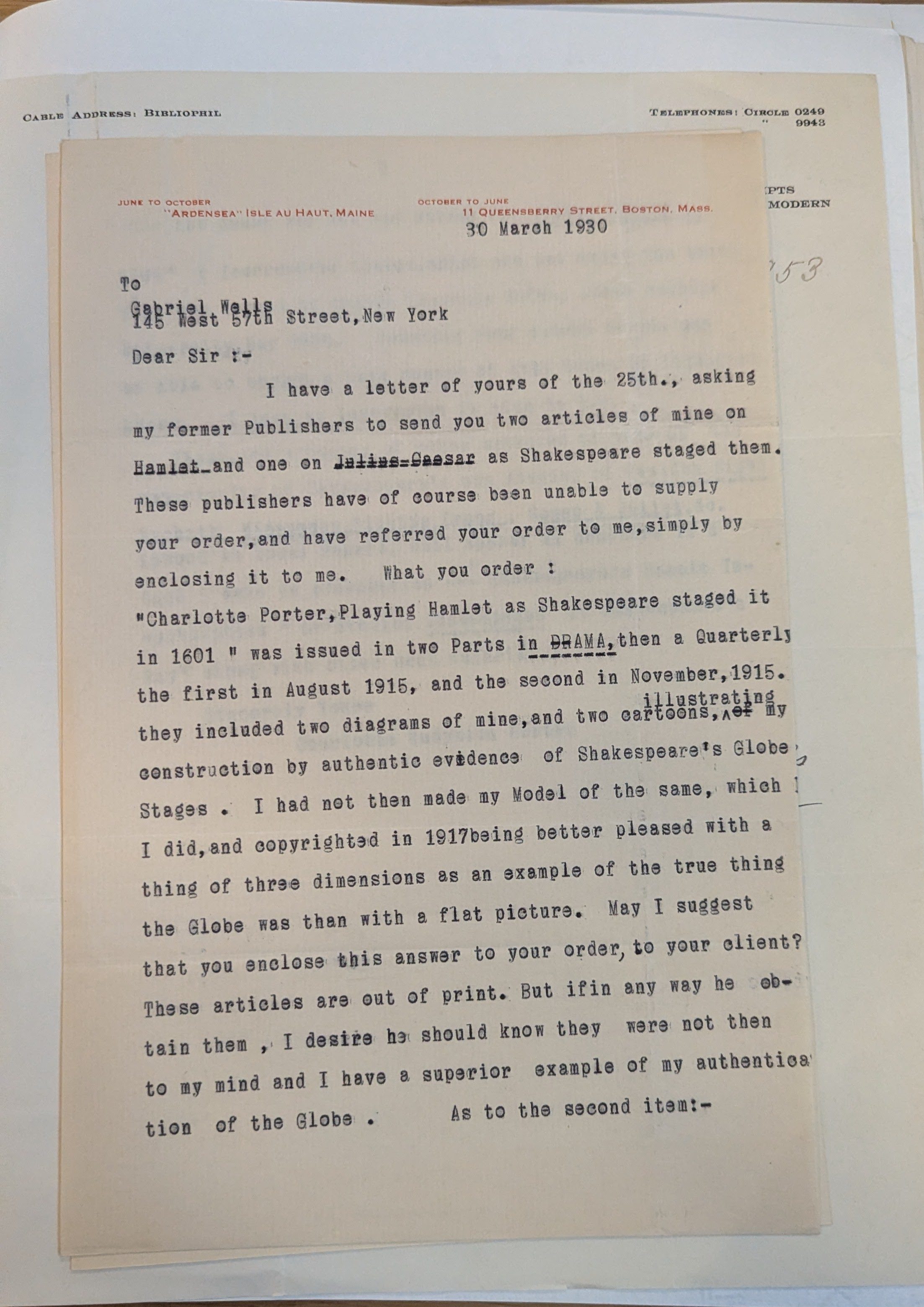
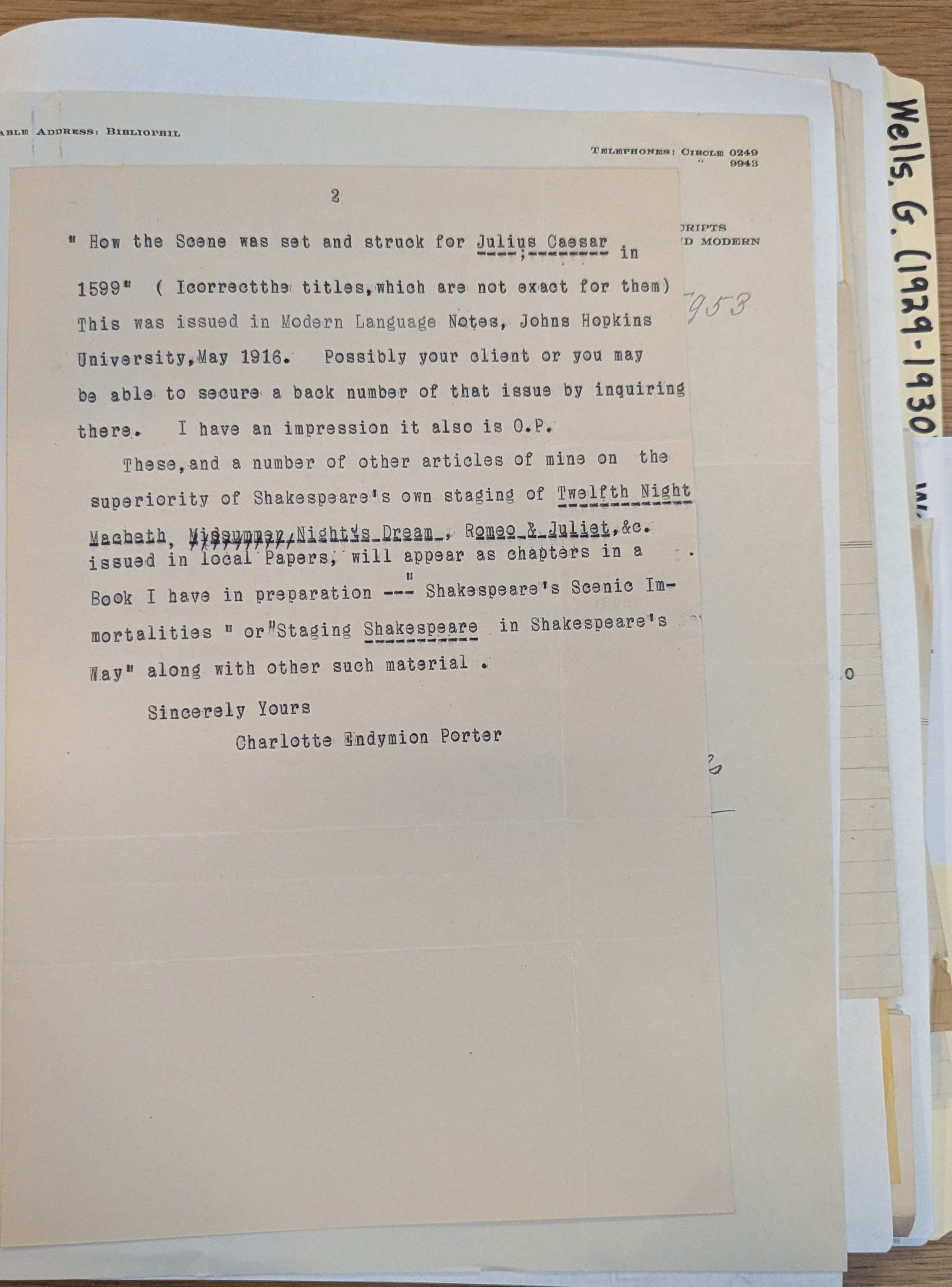
Letters from Charlotte Porter
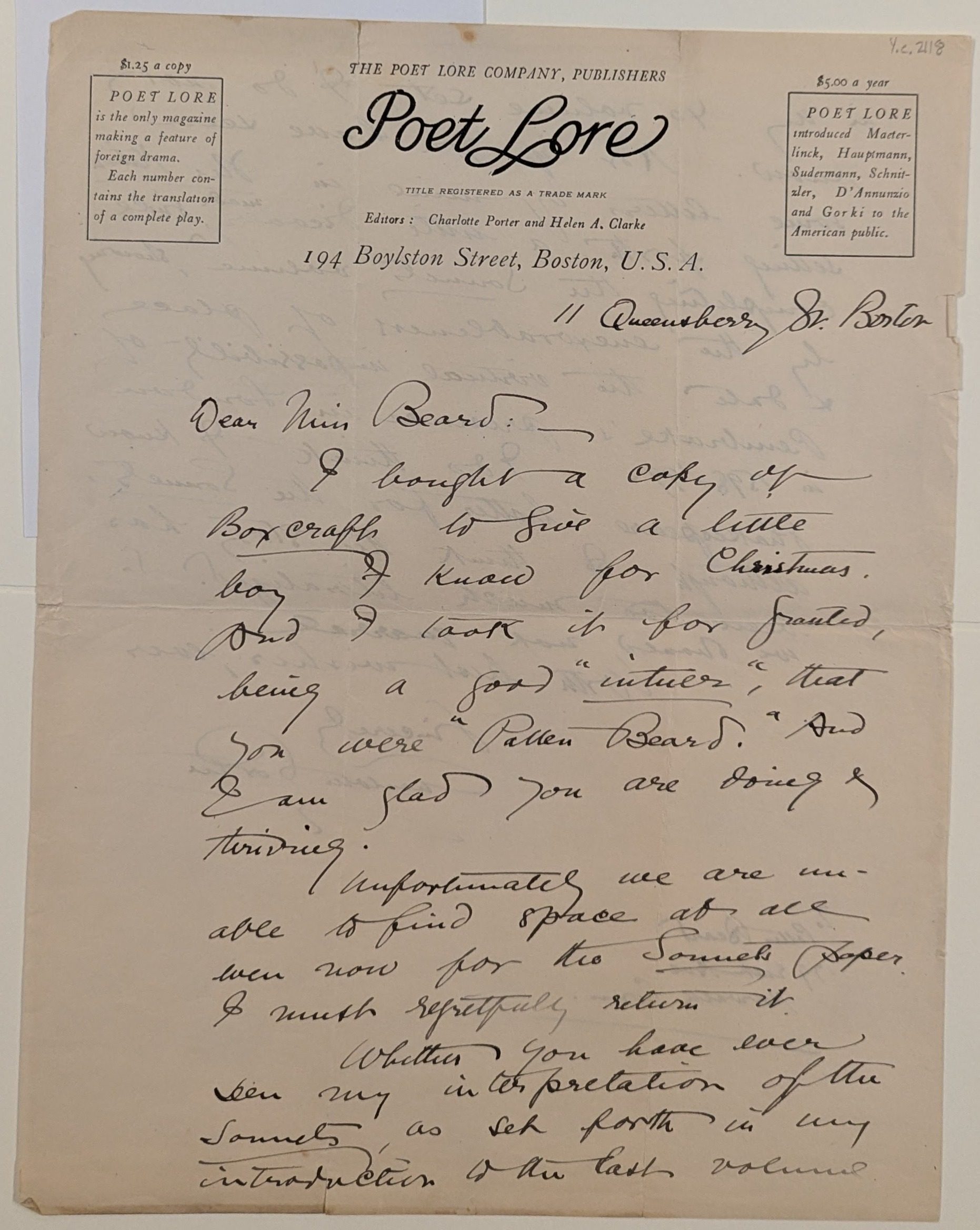

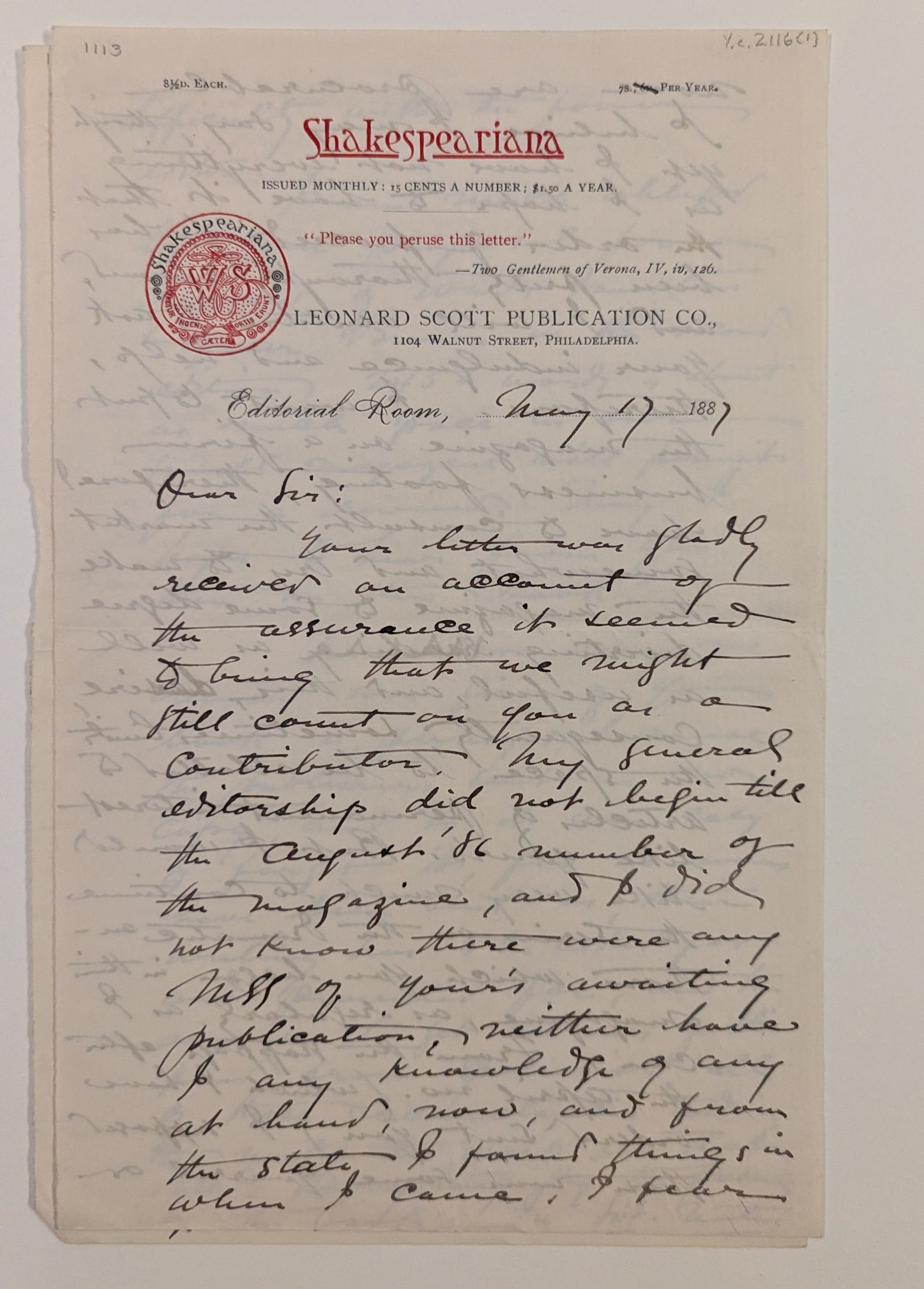
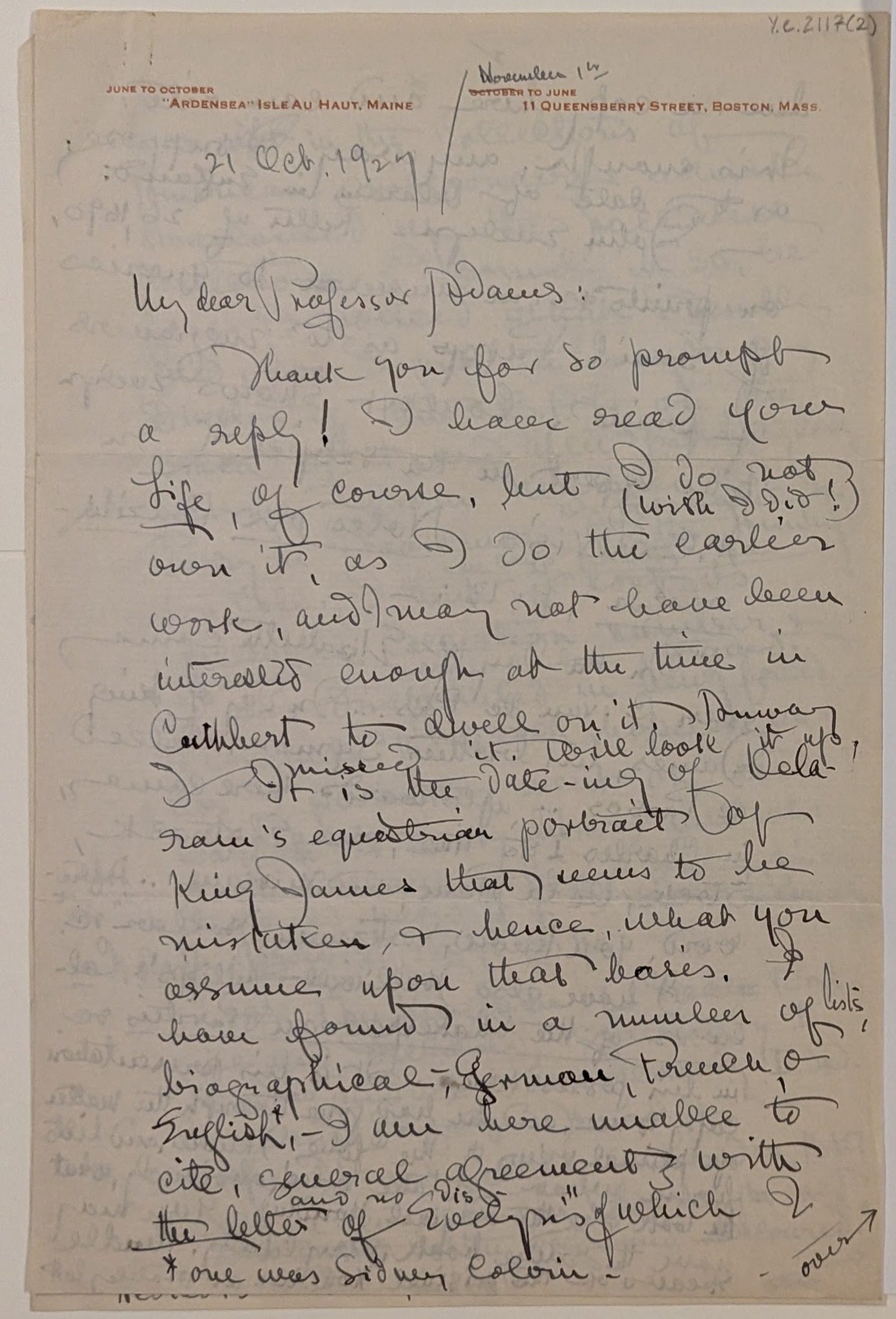
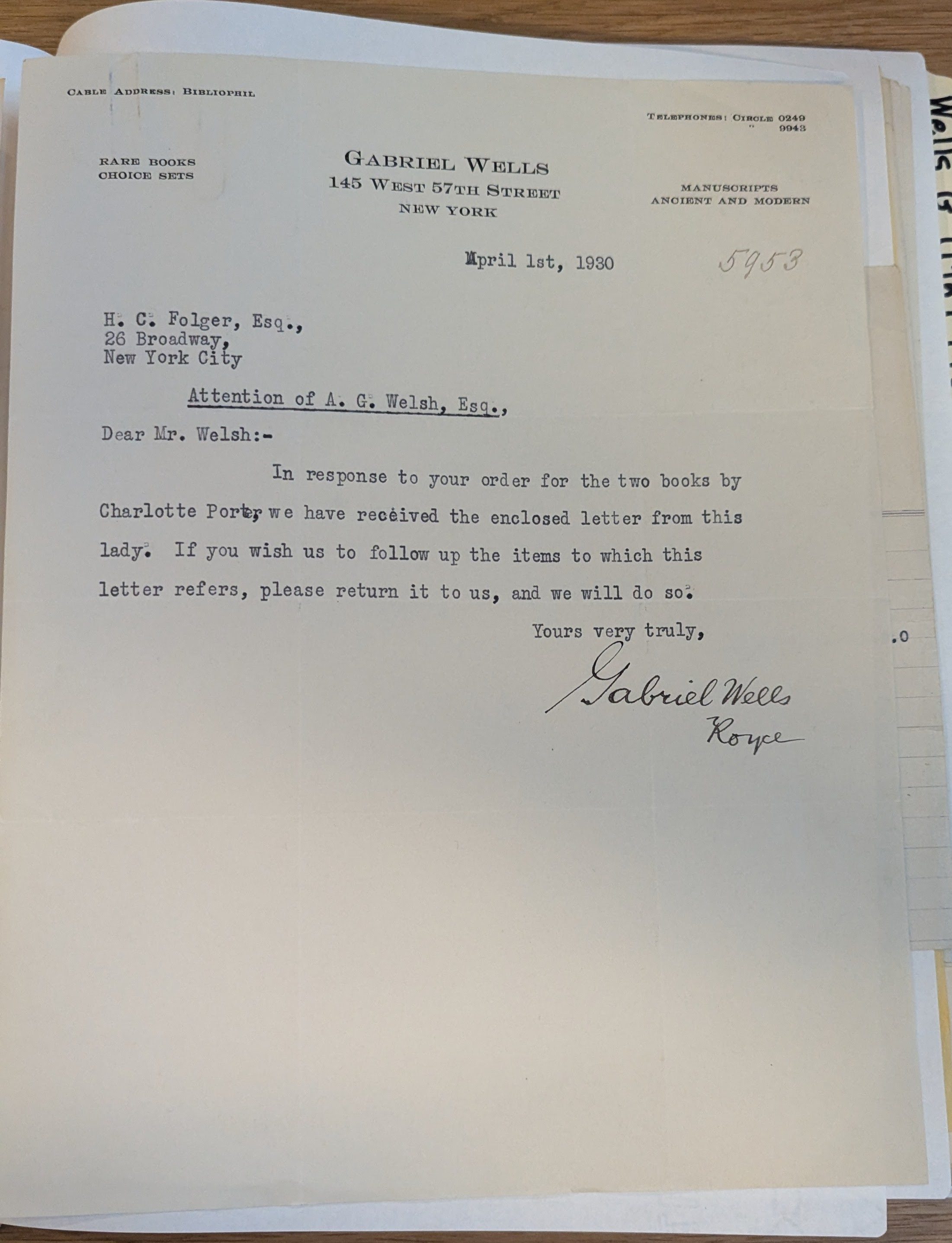
In addition to writing and editing side by side, they also lived together and financially supported each other. Porter and Clarke were life partners, dividing their time between Boston and Ardensea, a cottage on Isle-au-Haut, Maine, that they designed and built. Ardensea is a portmanteau referring to Shakespeare’s Forest of Arden and the Atlantic Ocean that they could see from the windows of their cottage). Ardensea had (and still has) a stone fireplace with an inscription from The Tempest in Porter’s large gothic script: “The air breathes upon us here most Sweetly / Here is everything advantageous to life.”

Those cyanotype portraits

In the circular image on the upper left, they are standing outside in front of a spiked iron fence, wearing gorgeous hats and smiling. Clarke looks down, left hand tucked into the pocket of her jacket, her other hand casually wrapped around a copy of the First Folio (most likely the Booth Reprint of the First Folio, printed in 1864, which Porter mentions buying second-hand in a later essay). Porter grins at us, clutching a copy of their brand-new edition of A Midsummer Night’s Dream in her left hand, her tie blowing outward and casting a shadow on her skirt. This image feels like a joyful celebration of their shared accomplishment.

The photograph beneath it is more intentionally staged. They kneel behind the iron fence, reaching through it to hold up the First Folio, open to the title page. Their little edition leans against the First Folio. They are looking at the books, and not at the camera. What were they trying to convey by this image behind bars? That they published their edition despite the barriers facing women in a field dominated by men? Are they setting their edition free from the gates of the university? Are they acknowledging their outsider status as queer co-editors?

In the third image, they sit next to each other in a book-lined office, at a desk stacked with papers. Their jackets are now off, and are their hands almost touching? A reproduction of the Mona Lisa and a rubbing of Shakespeare’s epitaph from Holy Trinity Church in Stratford-upon-Avon are framed on the wall behind them. The details of their faces have faded, or were they perhaps always a blur because they moved during the long exposure time? Were they smiling? Were they looking at each other or at us or at the mess on their desks, or perhaps all three, hence the blur?
These two women were trailblazers—brilliant, prolific, creative, and influential in shaping the emerging field of Shakespeare studies in the United States. They didn’t limit themselves to just Shakespeare, though. They also edited the works of Robert Browning and Elizabeth Barrett Browning.
The story of their relationship
When Clarke died in 1926, Porter honored her in the pages of Poet-Lore, their joint creation, with a lyrical tribute that reads like a love letter to their shared passions. Porter refers to herself as a “survivor” in the title of the essay, “A Story of Poet Lore, With Relation to the Late Helen A. Clarke, One of Its Founders, By the Survivor, Charlotte E. Porter.” Porter begins the essay with a description of the scattering of her partner’s ashes in the sea on July 1, after walking the familiar path from their cottage, past trees lovingly named by Clarke. She releases her “pure unbodied spirit in the blue sea at the loveliest moment of high tide,” just down from their beloved cottage in Maine, where they spent so many happy summers. She refers to Clarke as her “mate,” her comrade “in sickness and in health,” and wishes she could “give any glimpse of the distinction of her attractive youth, the rare versatility of her inborn gifts, and eager culture of them, her instant relish for beauty in all forms… Only those who knew her can understand it all.”
Their commitment to each other was solidified by a ring. This ring had belonged to Clarke as a child, its stones long lost. Porter tells the story of her restoration of the ring, to give as a gift to Clarke, and its subsequent loss to the sea, as a full circle moment to her releasing Clarke’s ashes to the sea:
I restored the ring with new glints of red and green, blue and topaz, and caused to be inscribed inside a line of Browning’s from ‘Pippa Passes.’ No one but she ever knew, I think, that it was inside the ring… We were voyaging eastward together alone, Helen and I, seated forward on deck when the line-engraved ring met with a strange chance. Only this July first association now makes the story of it worth while.
“I think, Charlotte, you will have to wear this ring for me now. It is getting too small to wear without hurting my littlest finger. Anyhow, take it for now.”
So I did, saying, “But see! It is a trifle loose for mine.” Then, in a moment, shaking the crumbs from our luncheon, over the corner of the taffrail went the ring and the sea closed above it. Laughingly we spoke of the Doges of Venice wedding the Sea and of the ring of Sakoontula, later still when I bought “Ardensea” and we made our summer home here we used to speak of it as a portent of this Isle.
Now it becomes a larger kind of symbol of the Sea of Eternal Life.
Her essay is followed by two poems by Clarke, and one by Porter, written after Clarke’s death, titled “What Loneliness.”

More on Charlotte Porter and Helen Clarke
Murphy, Andrew. Shakespeare in Print: A History and Chronology of Shakespeare Publishing, 2nd. ed. Cambridge: Cambridge University Press, 2021 (see 206-7 for the comments by the Oxford editors, from correspondence in the Oxford University Press archives.)
Navitsky, Joseph. “Charlotte Porter, Poet-Lore, and the Early Evolution of American Shakespeare Studies.” American Periodicals: A Journal of History & Criticism, vol. 31 no. 2, 2021: 117-33.
Porter, Charlotte. “A Story of Poet Lore, With Relation to the Late Helen A. Clarke, One of Its Founders, By the Survivor, Charlotte E. Porter,” Poet-Lore, 37 (1926), 432-57 (inclusive of the poems after the essay)
Roberts, Jeanne Addison. “Women Edit Shakespeare.” Chapter. In Shakespeare Survey, edited by Peter Holland, 136–46. Cambridge: Cambridge University Press, 2006.
Yarn, Molly G. “‘Give Ear, Sir, to My Sister’: Women Editors and Scholarly Networks in America.” Chapter. In Shakespeare’s ‘Lady Editors’: A New History of the Shakespearean Text, 79–110. Cambridge: Cambridge University Press, 2021.
Keep exploring

Molly Yarn on Shakespeare's 'Lady Editors'
While the names of the many of Shakespeare’s male editors are well-known, up until now there has been little to nothing written about another group of Shakespeare editors: women. Molly Yarn discusses Elizabeth Inchbald, Laura Valentine, Charlotte Stopes, and their editorial sisters.

The sanitized Shakespeare of Mary Lamb and Henrietta Bowdler - Excerpt: 'Shakespeare's Lady Editors' by Molly Yarn
As anyone who has read Shakespeare’s plays can attest, their content is not always very appropriate for children: brutal murders, bawdy jokes, incest, etc. Editions of Shakespeare’s plays that have been designed specifically for children often omit or smooth over…

Editing Shakespeare
Shakespeare Unlimited: Episode 31 Just what exactly does it mean to edit the works of Shakespeare, particularly since we have no surviving manuscript copies? Why is it that new editions of the plays continue to be published? In this episode…
Stay connected
Enter your email address to follow this blog and receive notifications of new posts by email.